
Why Fresh Pasta Made In-House Has Become Foodservice’s Most Practical Upgrade
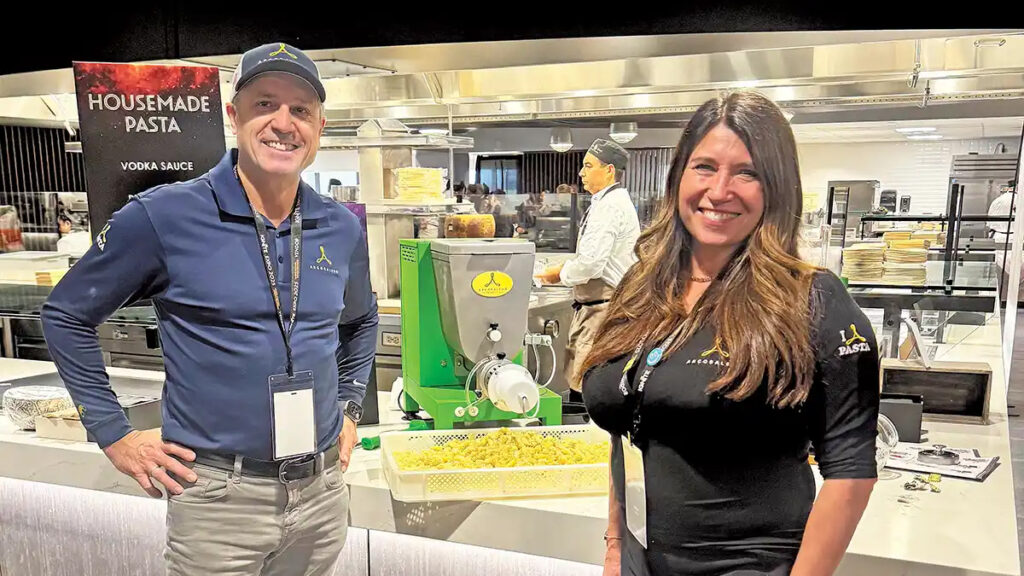
Antonio and Maja Adiletta, Founders of Arcobaleno, at the Flik Ignite Conference last month in Hartford, CT using the AEX20 Pasta Machine
The moment fresh pasta shows up on a menu, guests know the restaurant made a choice. Not a trend play. Not an indulgence. A clear signal that says quality is made here, not purchased by the case.
Operators who have made the switch see the same shift in guest behavior. They watch diners slow down. They hear them talk about the texture, the aroma, the way sauce clings. They notice plates come back nearly clean. Fresh pasta communicates care in a way guests don’t miss and that message builds loyalty no other ingredient can buy!
For many restaurants, moving from purchased pasta to fresh pasta made in their own kitchen becomes a defining part of their identity. It tells the community that this restaurant makes pasta from scratch and values authenticity. It also aligns perfectly with today’s operating model leaner teams, more focused menus, and the expectation to deliver a level of quality. Fresh pasta speaks for itself and delivers on all three
That shift has been seen in some of the country’s most influential kitchens. Arcobaleno Pasta Machines has become standard for operators who want creative control from neighborhood restaurants to globally recognized destinations. Carbone uses Arcobaleno Pasta Machines in multiple cities. Chef Robbie Felice, known for his pastaRAMEN, discovered a new appreciation for extruded pasta after tasting fresh pasta produced and cooked at Arcobaleno. College and pro sports teams, including chefs cooking for the Phillies and NBA athletes, rely on Arcobaleno systems to fuel high performance. Even large event operations, including World Cup soccer tournament, have turned to Arcobaleno for consistent production at scale. These partnerships prove that fresh pasta is no longer a specialty play. It has become a mainstream advantage.
Maja and Antonio Adiletta, Co-founders of Arcobaleno worked hands-on with many of these chefs. “Guests know when something is made for them in that moment, and operators can feel the shift in the room,” said Maja Adiletta. The Adilettas have long viewed fresh pasta not only as a menu item, but as a powerful storytelling tool.
Working with chefs over the years, Arcobaleno has helped develop menus that range from rustic to boundary pushing. Operators have created bucatini infused with roasted pepper broth. Others have added jalapeno juice as a substitute to water that carries heat without overwhelming the bite. Seasonal pumpkin Zucca has become a December favorite. Regional shapes like orecchiette, gnocchetti sardi, pizzoccheri, and cavatelli connect restaurants to Italian traditions and give diners something familiar yet new. Some chefs use custom dies to create signature shapes that appear nowhere else, from large calamarata rings for seafood pastas to playful shapes for family dining. “People forgot how fun pasta could be until they tried it again fresh,” Adiletta added. She said many of the most successful operators started with basic shapes. and have the ability to expand into our comprehensive library of pasta shapes, opening creative possibilities for customers across every menu style.
The simplicity of these machines is what made the transition possible. Making pasta in-house once required a skilled pasta maker and a large production window. Today a team member can load flour, liquid, and any flavor infusions into a single hopper. The machine mixes and extrudes in the same chamber, no separate mixer, no dough transfer. Cleanup stays manageable. “Teams can produce consistent pasta quickly, allowing operations with limited staff to offer high-quality fresh pasta,” Adiletta noted.
The labor story matters even more now. Kitchens facing higher wages and smaller staffs need equipment that can minimize prep time. Dry pasta requires either cooking from scratch for every order, which takes fifteen to twenty minutes, or par-cooking by a dedicated prep person. Fresh pasta cuts that to two or three minutes in rapid boiling water with no gummy re-thermalized texture and no wasted batches. That has allowed operators to improve ticket times, reduce the strain on the line, and serve pasta at peak quality even during rushes. “Fresh pasta cuts prep time and raises consistency, and that surprises a lot of chefs at first,” Adiletta noted.
Then comes the economics. The numbers always make operators stop and look twice. A fifty-pound bag of flour yields around sixty-five pounds of pasta. Depending on portion size, a plate of fresh pasta carries a food cost between eighteen and twenty-eight cents. Once operators run the math, the return becomes hard to ignore. For many, the machine pays for itself in about thirty days when producing roughly eighteen eight-ounce portions per day. That equates to around five hundred dollars in fresh pasta value per day at menu price levels many guests gladly accept, since fresh pasta feels premium without a premium cost. “The ROI of a starter Arcobaleno (AEX18/20) machine can be achieved in about thirty days,” Adiletta continued. She said many operators joked that the machines felt like they were printing money while freeing capital for other equipment needs.
The financial upside also comes from better inventory control. Fresh pasta production means restaurants make what they need instead of storing excess dry pasta or specialty fresh pasta from purveyors. It reduces overstocking. It trims storage. It helps operators adjust to demand swings and eliminate waste. For kitchens under pressure to streamline SKUs, fresh pasta becomes both a creative win and an operational win.
The wide library of shapes adds another layer of advantage. Arcobaleno maintains around two hundred dies, including regional, seasonal, and custom shapes. Operators can introduce a custom shape no competitor in the market uses. That uniqueness becomes a marketing point. It also lets restaurants craft seasonal dishes tied to produce, weather, or local stories. Fresh buckwheat pizzoccheri with cabbage and potatoes in winter. Jalapeno Radiatore in summer. Ricotta infused Cavatelli for brunch. Beet infused Heart-Atoni for Valentine’s menus. Mushroom powder Pappardelle for fall. “Operators would come in thinking they only wanted basic shapes, then they would see the library,” Adiletta detailed. “That is usually when they start imagining what their menu could look like in the fall, in the spring, or tied to a local story.”
Support is what makes all of this stick. Arcobaleno helps operators plan kitchen layout, choose the right machine size, explore shapes, and build workflow so the program runs smoothly. They offer virtual training, test kitchen sessions, FaceTime-based tech support, and on-site help when needed. “We guide operators through the whole process,” Adiletta outlined. “They are not just buying a machine. They are building a program, and we stay with them as that program grows.”
Looking ahead, Arcobaleno plans to expand the support ecosystem even further. One of the biggest initiatives is ARCOBALENO PASTA U, a structured education program that will teach pasta making at a professional level. It will cover everything from dough science, shelf stability, to shape pairing, plus value added products like lasagna, cannelloni, and filled pastas. It aims to help operators, new business owners, and culinary teams learn the craft without needing to travel overseas. Courses will be available both in person and online. The program ties into another future aim: the potential for Arcobaleno to import or private-label specialized flour that simplifies sourcing and ensures ideal results. Many kitchens struggle to find the right semolina. Offering a consistent flour option would give operators a seamless start. “We are building Pasta U because education completes the circle,” Adiletta continued. “The right knowledge helps operators unlock everything fresh pasta can do. We Make Pasta Happen!”
The expansion of service and education matches the growing demand from restaurants, hotels, caterers, universities, and sports nutrition programs. Arcobaleno’s fresh pasta solution has become a menu anchor that fits high volume, fast casual, fine dining, and everything in between. It satisfies guests looking for comfort and creativity while maximizing profits for operators. Because Arcobaleno’s pasta machines and cookers are compact and designed for small footprint installations, they work even in kitchens where space is limited. “Confidence helps chefs build menus they’re proud of, and fresh pasta becomes the piece that keeps bringing guests back,” Adiletta concluded.
For restaurants, foodservice operators, and distributors ready to explore fresh pasta or build a full program, Arcobaleno can help map the process from idea to plate. Operators can reach out directly to Arcobaleno to begin planning and follow us @arcobalenopasta #makingpastahappen