
For more information, call 717-394-1402 and press 5 for Sales, or email info@arcobalenollc.com.
Fresh Pasta Turns National Pasta Month Celebration Into Year-Round Profit and Menu Strategy
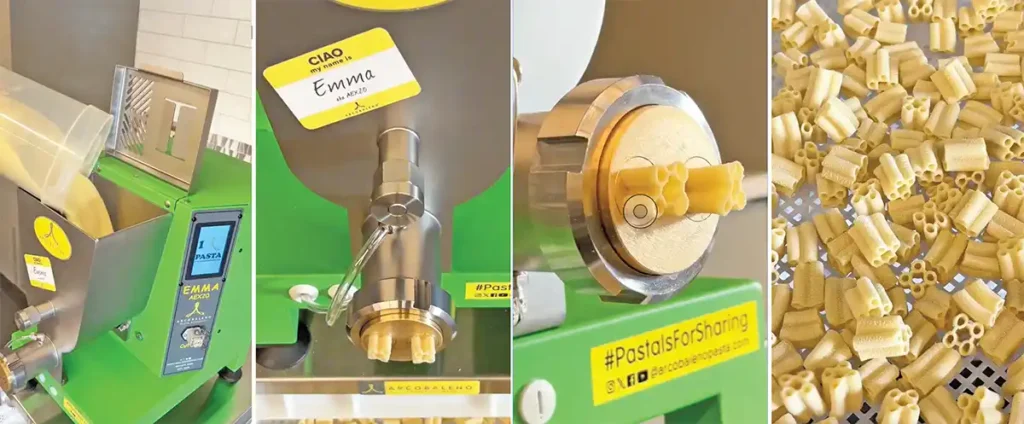
(L to R) (1) Ingredients are added to the Arcobaleno AEX20 Emma’s mixing chamber; (2) fresh pasta begins emerging through the brass die; (3) the die forms the pasta into its distinctive multi-tube shape; and (4) the finished pieces collect on a perforated pasta tray.
This month’s celebration of National Pasta Month gives restaurant and foodservice operators an opportunity to celebrate one of the world’s most enduring foods. But for operators facing continued pressure from food costs, labor expenses and the need to differentiate their menus, the month can also serve as a reason to take a fresh look at how pasta is produced in their own kitchens.
Rather than simply adding another pasta special for October, operators may find a larger opportunity in bringing pasta production in-house. Advances in extrusion equipment, repeatable recipes and training have made fresh pasta production far more approachable than the highly specialized, labor-intensive craft many operators still envision.
For Maja Adiletta, Co-Founder & CEO of Arcobaleno, National Pasta Month is an ideal time for operators to consider making fresh pasta part of the restaurant’s identity. “Fresh pasta creates an experience from simple ingredients,” Adiletta said. “It’s flour and water. You control what goes in, there are no preservatives, and you’re making something fresh that becomes part of the story of your restaurant.”
National Pasta Month, held each October, was established in 2011 by the U.S. National Pasta Association to encourage people to enjoy pasta in both traditional and new ways. National Pasta Day, celebrated October 17, gives restaurants another natural promotional opportunity in the middle of the month. For operators, however, the potential goes beyond an October promotion.
“Fresh pasta gives a restaurant an immediate point of difference,” Adiletta added. “People today recognize quality. They come in, they see that you’re doing something different, and they start to associate that experience with your restaurant. Then you start asking, ‘What else can we do?’ It becomes part of your identity.”
That differentiation can also give chefs another tool for seasonal menu development. Changing a pasta die allows a kitchen to move from rigatoni to bucatini, spaghetti, lasagna sheets, radiatori and numerous specialty shapes without rebuilding the production process.
For pasta-centric restaurants with sufficient volume, Adiletta said the company has seen equipment payback calculated in as little as 30 to 90 days. Other operations might look at six months to a year, depending on production volume and menu mix. The goal, however, is not simply to put a pasta extruder into every kitchen. Adiletta said the process should begin with the menu and work backward. “We start with the menu,” she said. “What do you want to make? Do you want extruded pasta, filled pasta or something hand-rolled with a sheeter? How much do you want to make every day? What is your portion size, and how many portions are you expecting? Once we understand that, we can determine the production capacity, workflow and right size machine.”
Production can also scale as a pasta program grows. Adiletta said customers frequently begin with one production level and eventually move to larger equipment as the menu gains traction. “A lot of customers outgrow the machine because the pasta program turns into something larger than they expected,” she added. “They start at one production level, it gains momentum, and then they want to do more.”
Arcobaleno supports that process through its Lancaster, PA flagship facility and more than 17 demonstration and experience centers around the country, giving operators opportunities to test equipment and better understand production before committing to a program.
Arcobaleno will also feature a highly anticipated community initiative in the company’s hometown of Lancaster, Pennsylvania. Throughout October Arcobaleno is holding a silent auction for an Arcobaleno AEX18 Pasta Extruder. The winner will receive the machine with a pasta cutter for short pastas and two standard pasta dies of choice. Arcobaleno will donate the auction proceeds to the Lancaster Science Factory, which supports STEM learning in its local community.
Arcobaleno Tradition Pasta Die Sale Is Back! – Making Pasta Happen All Month Long
For operators considering whether October should be the month they finally explore fresh pasta, Adiletta believes the starting point is simply understanding what they want their menu to become. “It’s not just about buying a machine,” Adiletta concluded. “You need the right equipment, training and support for what you want to produce. The work really continues after the sale. That’s when you help the operator make fresh pasta part of what they do every day.”
Restaurant and foodservice operators interested in exploring an in-house fresh pasta program can connect directly with Arcobaleno to discuss menu goals, production requirements, kitchen workflow, demonstrations and equipment options.